Why Traditional Retail Management Fails Today
Let’s be honest; running a department store manually in today’s fast-paced retail world is like trying to win a Formula 1 race on a bicycle. You might move forward, but you’ll always be left behind. Traditional retail systems rely heavily on spreadsheets, manual billing, and guesswork-based inventory tracking. These outdated methods often lead to stock mismatches, billing errors, and long customer queues, which ultimately hurt your business reputation.
Think about it: how many times have store owners struggled with “missing stock” or incorrect billing totals? Manual processes increase the chances of human error, especially when dealing with hundreds or thousands of products daily. According to recent retail insights, businesses using automated systems significantly reduce stock discrepancies and improve operational accuracy.
Retail today demands speed, accuracy, and real-time decision-making. Customers expect quick billing, product availability, and seamless shopping experiences. If your store still depends on manual processes, you're not just losing efficiency; you’re losing customers. That’s where department store management software steps in as a game-changer, helping businesses move from chaos to control.
The Rise of Smart Retail Software
Retail is no longer just about selling products; it’s about managing data, understanding customer behavior, and optimizing operations. Smart retail software has emerged as the backbone of modern stores, integrating billing, inventory, and analytics into one unified system. This shift isn’t just a trend; it’s a necessity.
Modern systems connect billing counters, warehouses, and even online stores in real time. When a product is sold, inventory updates instantly across all platforms. This seamless integration eliminates confusion and ensures that everyone, from store staff to managers, works with accurate data.
What makes this evolution even more exciting is automation. Tasks that once took hours, like stock counting or invoice generation, now happen in seconds. Retailers can focus on growth strategies instead of getting stuck in daily operational headaches. In simple terms, retail software acts like a “brain” for your store, constantly analyzing, updating, and optimizing every process.
What is Department Store Management Software?
Core Definition and Purpose
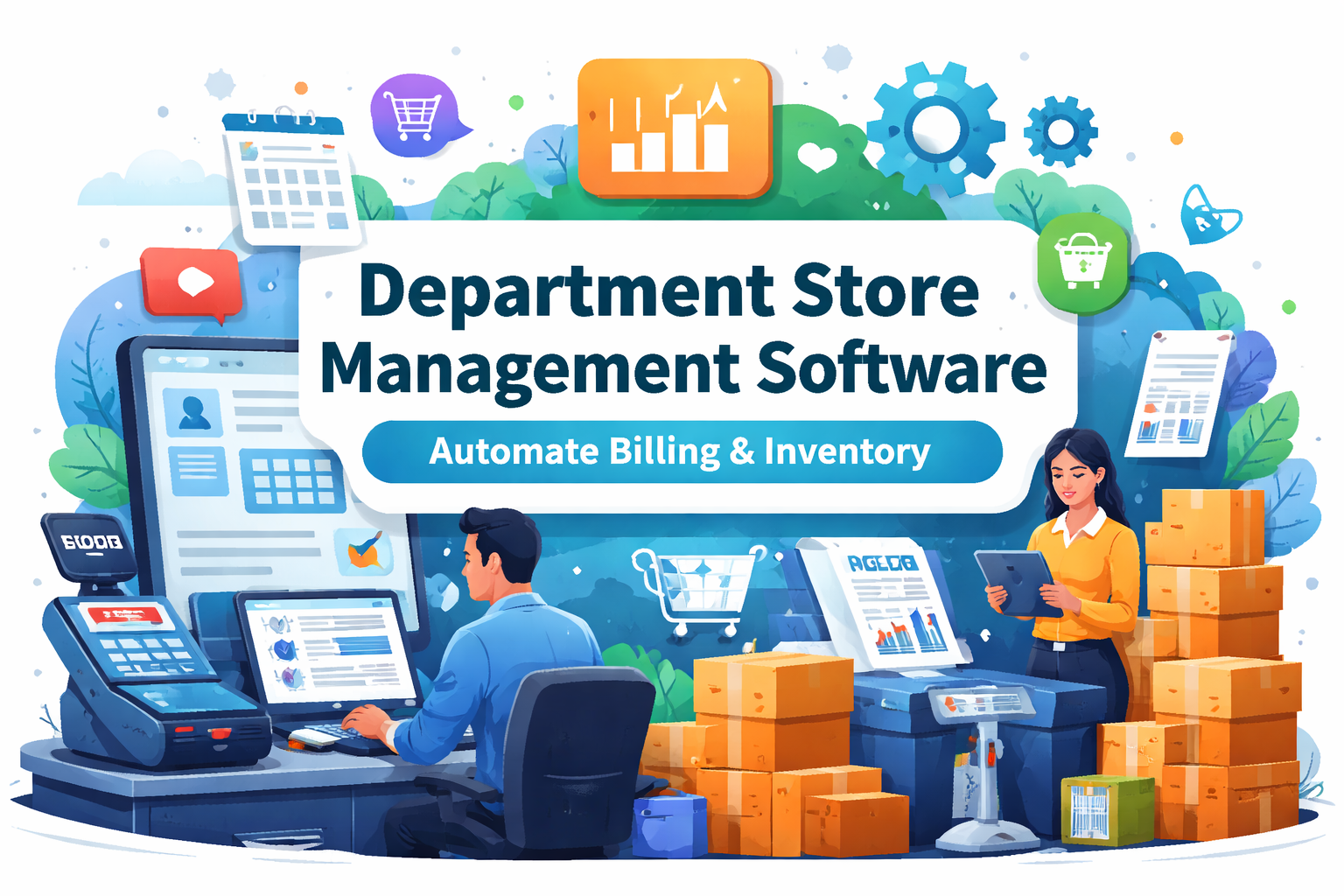
At its core, department store management software is an all-in-one solution designed to manage every aspect of a retail business, from billing and inventory to customer data and reporting. It acts as a centralized system that brings all store operations under one digital roof.
This software typically includes modules like POS (Point of Sale), inventory tracking, accounting, CRM, and analytics. Instead of juggling multiple tools or manual records, store owners can manage everything from a single dashboard.
The main purpose? To simplify operations, reduce manual work, and improve accuracy. Whether you run a small grocery shop or a large departmental chain, this software helps you stay organized and efficient. It’s like having a virtual manager that never sleeps.
Key Components of Retail Software
A powerful retail management system isn’t just one tool—it’s a combination of several essential components working together:
POS System for billing and transactions
Inventory Management System for stock tracking
CRM for customer data
Accounting Module for financial records
Analytics Dashboard for insights
Each component plays a critical role. For example, when a sale is made at the POS, the inventory system updates automatically, and the accounting module records the transaction. This interconnected ecosystem ensures smooth and error-free operations.
Importance of Automating Billing in Retail
Challenges of Manual Billing
Manual billing might seem manageable when you have a handful of customers, but as your store grows, it quickly becomes a nightmare. Long queues, calculation errors, and inconsistent pricing are just the beginning of the problems.
Imagine a busy supermarket during peak hours. Customers are waiting, staff are stressed, and one small mistake can create a domino effect of issues. Manual billing not only slows down operations but also damages customer trust.
Errors in tax calculations or pricing can lead to compliance issues, especially in countries like India where GST regulations are strict. Without automation, maintaining accuracy becomes nearly impossible.
Benefits of Automated Billing Systems
Automating billing is like switching from a manual typewriter to a modern laptop; it transforms the entire workflow. With barcode scanning and instant invoice generation, billing becomes faster, more accurate, and hassle-free.
Automated billing systems reduce queues, improve customer satisfaction, and ensure accurate tax calculations. They also support multiple payment methods, making transactions smoother.
More importantly, every sale is recorded in real time, providing valuable data for analysis. Store owners can track sales trends, identify best-selling products, and make informed decisions. In short, automated billing for retail is not just a feature; it’s a necessity for growth.
Understanding Inventory Management Systems
How Inventory Software Works
An inventory management system acts like a digital watchdog for your stock. It tracks every product movement—from purchase to sale; ensuring that your inventory data is always accurate.
Using technologies like barcode scanning and real-time updates, the system automatically adjusts stock levels whenever a transaction occurs. This eliminates the need for manual stock counting and reduces errors significantly.
The system also generates reports, helping you understand which products are selling fast and which are not. This data-driven approach allows you to optimize your inventory and avoid unnecessary losses.
Real-Time Inventory Tracking Explained
Real-time tracking is one of the most powerful features of modern inventory systems. It ensures that your stock data is always up to date, no matter how many transactions occur.
For example, if a product is sold at one branch, the system updates the stock across all locations instantly. This prevents overselling and ensures accurate stock availability.
Real-time tracking also helps in demand forecasting. By analyzing sales patterns, the system predicts future demand, allowing you to restock efficiently. This means no more empty shelves or overstocked warehouses.
Key Features of Department Store Management Software
POS Integration
The POS system is the heart of retail operations. It handles billing, payments, and customer interactions. A well-integrated POS ensures that every transaction is recorded accurately and linked to inventory and accounting systems.
Multi-Store Management
For businesses with multiple outlets, managing operations can be challenging. Retail software provides centralized control, allowing you to monitor all stores from one dashboard.
Reporting and Analytics
Data is the new currency in retail. Advanced reporting tools provide insights into sales trends, customer behavior, and inventory performance, helping you make smarter decisions.
Benefits of Using Retail Management Software
Increased Efficiency
Automation streamlines operations, reducing the time spent on repetitive tasks. Employees can focus on customer service instead of manual work.
Reduced Errors and Costs
By eliminating manual processes, software reduces errors and operational costs. It also helps prevent overstocking and stockouts, saving money in the long run.
Medical Store Management Software: A Specialized Use Case
Unique Needs of Pharmacy Retail
Pharmacies have unique requirements compared to general retail stores. They need to track expiry dates, batch numbers, and regulatory compliance.
Compliance and Expiry Management
Medical store management software ensures that expired products are flagged and removed, reducing risks and ensuring customer safety.
How Automation Improves Customer Experience
Faster Billing
Quick billing means shorter queues and happier customers.
Personalized Shopping
CRM integration allows stores to offer personalized discounts and recommendations.
Comparison Table: Manual vs Automated Systems
Choosing the Right Software for Your Business
Factors to Consider
Look for scalability, ease of use, integration capabilities, and customer support.
Common Mistakes to Avoid
Avoid choosing software based only on price. Focus on long-term value and features.
Future Trends in Retail Software
AI and Predictive Analytics
AI helps predict demand and optimize inventory.
Cloud-Based Solutions
Cloud systems offer flexibility, scalability, and remote access.
Conclusion
Department store management software is no longer optional—it’s essential. From automating billing retail processes to managing inventory efficiently, it transforms how businesses operate. Whether you run a supermarket, clothing store, or pharmacy, adopting the right software can significantly boost your efficiency, accuracy, and profitability.
FAQs
1. What is department store management software?
It’s a system that manages billing, inventory, sales, and customer data in one platform.
2. How does automated billing help retailers?
It speeds up transactions, reduces errors, and improves customer satisfaction.
3. What is an inventory management system?
A tool that tracks stock levels, sales, and product movement in real time.
4. Is medical store management software different?
Yes, it includes features like expiry tracking and compliance management.
5. Can small businesses use retail software?
Absolutely. Many solutions are scalable and affordable for small retailers.