
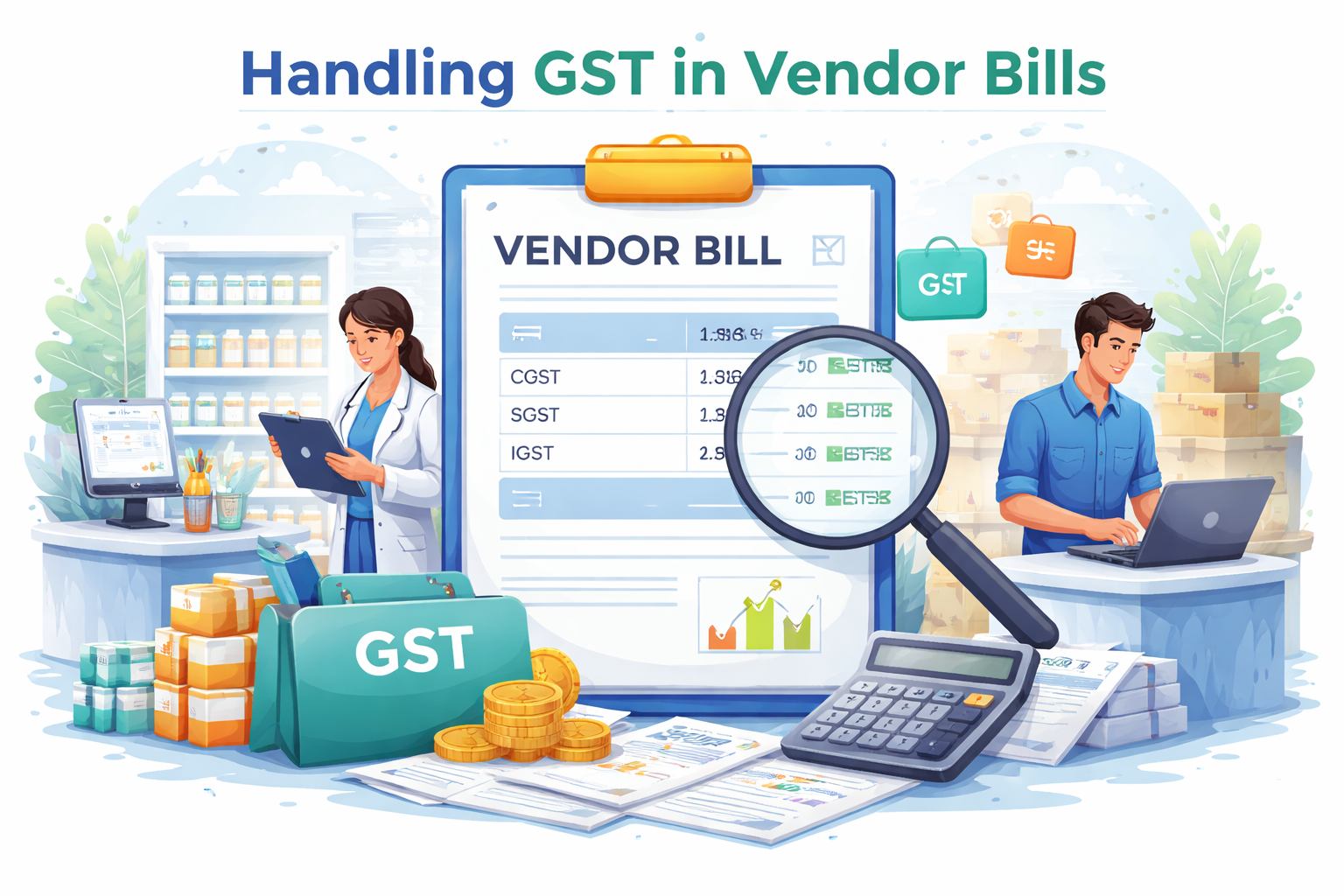
Managing GST in vendor bills is one of the most important parts of running a retail or medical store. If not handled properly, it can lead to incorrect tax filing, penalties, or loss of input tax credit (ITC). Whether you are using store management software or handling bills manually, understanding how GST works in vendor billing is essential for smooth business operations.
In this guide, you’ll learn how to handle GST in vendor bills step-by-step, along with practical tips for vendor bill management, retail store management, and cash management.
Table of Contents
- What Is GST in Vendor Bills?
- Why GST Handling Is Important in Vendor Bill Management
- Types of GST in Vendor Bills
- Step-by-Step Process to Handle GST in Vendor Bills
- GST in Medical Store Management
- Common Mistakes in GST Vendor Billing
- Role of Store Management Software
- GST and Cash Management in Retail
- Conclusion
What Is GST in Vendor Bills?
The Goods and Services Tax, or GST, is a tax that is imposed on purchases of goods and services. When you receive a bill from a vendor, it includes GST charged on the items you purchased.
A typical vendor bill includes:
- Vendor name and GSTIN
- Invoice number and date
- Product details
- Taxable amount
- GST rate (5%, 12%, 18%, etc.)
- Total bill value
For example, if you purchase medicines or retail goods, the vendor charges GST, which you can later claim as Input Tax Credit (ITC) if all details are correct.
Why GST Handling Is Important in Vendor Bill Management
Proper GST handling ensures:
- Accurate tax filing
- Eligibility for Input Tax Credit (ITC)
- Avoidance of penalties
- Clean accounting records
If GST is entered incorrectly in your system, you may lose ITC or face mismatches during GST returns.
In vendor bill management, GST accuracy directly affects your profit margins. Even small mistakes can lead to financial losses.

Types of GST in Vendor Bills
Understanding the type of GST applied is crucial.

Example:
- If you buy goods within your state → CGST + SGST
- If you buy goods from another state → IGST
Correct classification is important for proper GST filing.
Step-by-Step Process to Handle GST in Vendor Bills
Handling GST becomes easy when you follow a structured process.
1. Verify Vendor Details
Always check:
- GSTIN of vendor
- Invoice number
- Billing date
An incorrect GSTIN can lead to rejection of ITC.
2. Check Tax Calculation
Ensure:
- The correct GST rate is applied
- The tax amount matches the taxable value
Even a small mismatch can cause issues during return filing.
3. Record the Bill in Your System
Enter all details into your store management software or accounting system:
- Item name
- Quantity
- Price
- GST percentage
- Total amount
Automation helps reduce manual errors.
4. Classify Input Tax Credit (ITC)
Separate:
- Eligible ITC
- Non-eligible ITC
Only eligible GST can be claimed in returns.
5. Match with GST Portal (GSTR-2B)
Before filing returns, match vendor invoices with your GSTR-2B report.
This ensures:
- The vendor has uploaded the invoice
- GST credit is valid
6. Maintain Proper Records
Keep digital or physical copies of:
- Vendor invoices
- Payment proofs
This is important for audits and compliance.
GST in Medical Store Management
Handling GST in medical store management requires extra attention because medicines fall under different tax slabs.
Common GST rates in medical stores:
- 5% for essential medicines
- 12% for certain drugs
- 18% for equipment and accessories
Medical store owners must:
- Track batch-wise inventory
- Ensure correct GST classification
- Maintain expiry and stock records
Using medical store management software simplifies this process by automatically applying correct GST rates.
Common Mistakes in GST Vendor Billing
Many retailers make avoidable mistakes while handling GST.
1. Incorrect GST Rates
Applying the wrong tax rate leads to incorrect returns and penalties.
2. Missing Vendor GSTIN
Without GSTIN, you cannot claim Input Tax Credit.
3. Not Matching GSTR Reports
Failing to match invoices with GSTR-2B can result in ITC loss.
4. Manual Data Entry Errors
Manual billing increases the chances of mistakes.
5. Ignoring Reverse Charge Mechanism (RCM)
Some transactions require GST to be paid by the buyer.
Avoiding these mistakes can save both time and money.
Role of Store Management Software
Modern store management software plays a crucial role in GST handling.
It helps in:
- Automatic GST calculation
- Error-free billing
- Real-time inventory updates
- Easy GST return reports
- Vendor bill tracking
Instead of manually calculating taxes, the software does everything instantly. This reduces workload and improves accuracy.
For growing retail businesses, using software is no longer optional—it’s essential.
GST and Cash Management in Retail
GST directly impacts cash management in retail stores.
When you purchase goods:
- You pay GST to the vendor
- Later, you claim ITC
This affects your working capital.
Proper GST management ensures:
- Better cash flow
- Accurate tax payments
- No excess tax burden
Retailers who manage GST efficiently can maintain healthier financial stability.
Conclusion
Handling GST in vendor bills is a critical part of retail store management and vendor bill management. It ensures compliance, improves cash flow, and helps claim accurate Input Tax Credit.
By following a structured approach, verifying invoices, recording data correctly, matching GST returns, and using store management software, businesses can avoid errors and simplify operations.
For medical stores and retail shops, adopting automation tools and maintaining proper GST records can make a huge difference in efficiency and profitability.
In simple terms, accurate GST handling is not just about compliance, it’s about running a smarter and more profitable business.